An open data infrastructure for digital agriculture.
Digital agriculture is not failing because of AI — it is failing because of data infrastructure. AgriFoodData is the reference implementation of the ITU/FAO architecture: an open, multi-party platform that lets farmers, services, machinery and administrations interoperate without displacing existing systems.
Why the world needs an open agricultural data infrastructure.
Three structural problems keep digital agriculture from scaling. They are not problems of model quality or compute — they are problems of data infrastructure. The AgriFoodData platform answers all three at the same time.
A fragmented system landscape
Farmers work with many vendors, devices and apps — which typically do not talk to each other. Data is captured redundantly, transferred manually, and kept in proprietary silos. The result is a landscape where no party sees the full picture.
Unresolved data sovereignty
Farmers fear losing control over operational data. Without technically enforceable, fine-grained access control, mistrust remains the principal adoption barrier — regardless of how compelling the proposed service is.
A chicken-and-egg dilemma
Value grows with available services — but vendors only invest once the user base is large enough. This network-effect hurdle prevents scaling in closed ecosystems and keeps digital agriculture permanently below critical mass.
Digital agriculture is not failing because of AI — it is failing because of data infrastructure. For the first time there is a globally agreed reference architecture, from the ITU and the FAO.
An integration layer, not a replacement.
The architecture explicitly promotes interoperability without displacing existing systems. It functions as an integration layer — which is the structural answer to the chicken-and-egg dilemma every closed agricultural platform runs into.
Six consented building blocks. Four OpenAPI interfaces. One canonical object.
The ITU/FAO reference architecture specifies six conceptual blocks. Each block can be implemented by different vendors as long as the contracts at the integration boundaries are honoured. AgriFoodData provides a reference implementation of all six.
- 01 · ROLESActor roles — farmers, services, sensors, machinery, certification, developers.→
- 02 · SYSTEMCore components — digital farm twin, registry, IAM, app store, dashboard.→
- 03 · DATAData models — JSON-LD and Web of Things vocabularies.→
- 04 · APIInterfaces — data, service, scheduling, clearing house connectors.→
- 05 · SERVICESService registry — REST API and SDK-based deployment.→
- 06 · SPACESData spaces — Gaia-X and IDSA — controlled exchange, no islands.→
Six blocks. Implementable by anyone. Operated as one platform.
Each block is a clear contract. Vendors can implement any block independently — the only commitment is to the integration boundaries the reference architecture defines.
Actor roles
Farmers, service providers, sensor and machinery vendors, certification bodies and developers — defined as platform-neutral roles.
Read reference →Core components
Digital farm twin, farm registry, app and service store, IAM, dashboard and decision support.
Read reference →Data models
Farm registry, fields, ROIs, agronomic information, operations and outcomes — on JSON-LD and Web of Things.
Read reference →Interfaces
Data, service, scheduling and clearing-house connectors — for data apps and FMIS integration.
Read reference →Service registry
Standardised REST API and SDK-based deployment for AI services — integrate once, available platform-wide.
Read reference →Gaia-X & IDSA
Controlled data exchange via existing data-space standards and catalogues — no new island solutions.
Read reference →From state to farm — satellite-based soil monitoring for all of Telangana.
A unified technical foundation for government, MAOs and individual farmers. ITU/FAO-conformant open-source code, identical models, same data — three audiences, one digital farm twin.
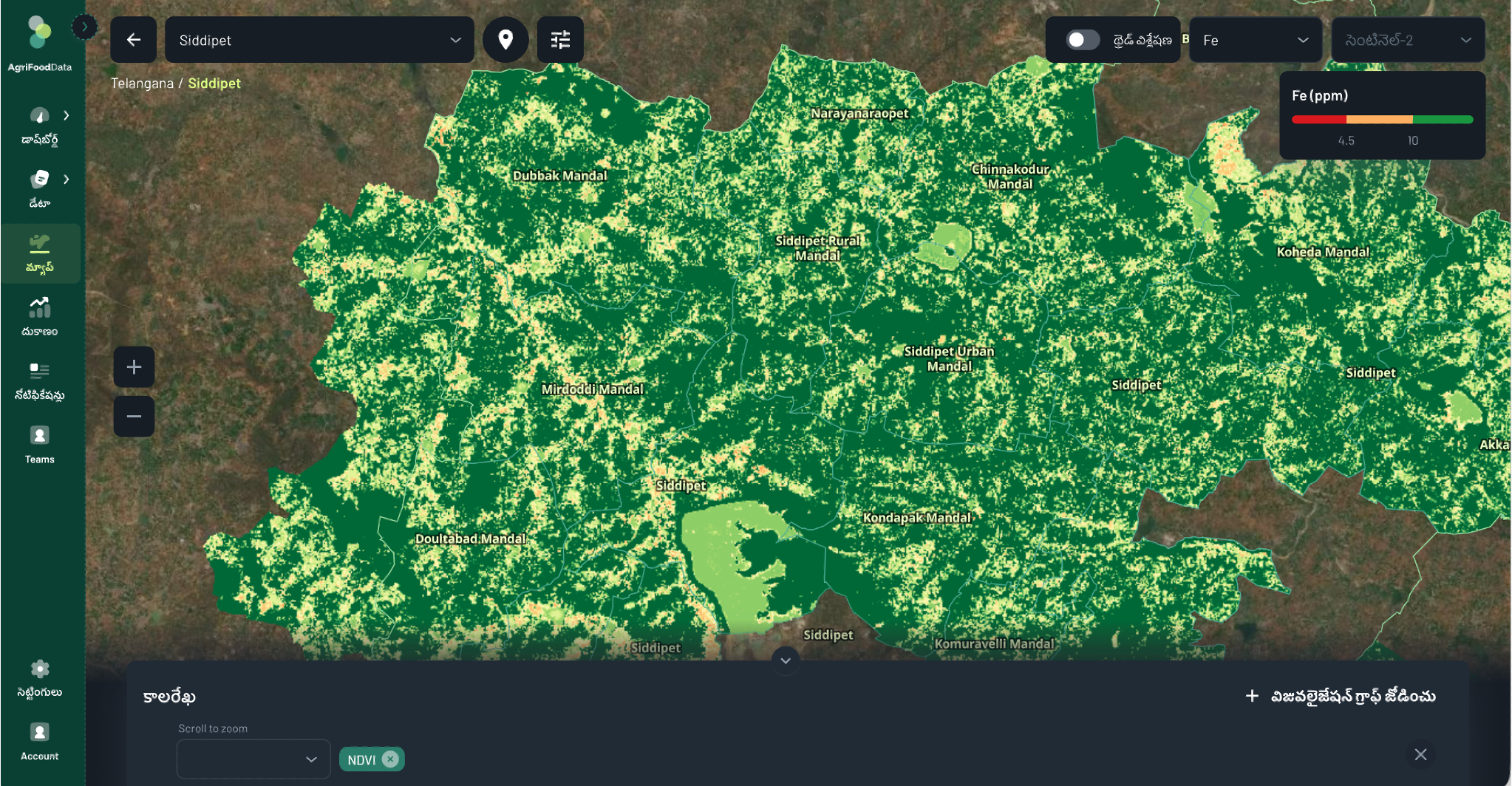
Aggregate vegetation index across districts. Used by the state government and PJTSAU for programme oversight and policy targeting.
Ten soil and crop parameters per mandal. Used by Mandal Agricultural Officers (MAOs) for advisory and intervention planning.
Time-series at the field level. Used directly by farmers through their existing FMIS or the platform's farmer-facing front-end.
Four pathways into the documentation.
The docs are organised by reader. Pick a pathway — each one is a curated, narrative route through the material rather than a flat index of pages.
Build an integration
OpenAPI specs, the digital-farm-twin data model, the SDK, and a 20-minute quickstart.
Open the API reference →Run the platform
Deployment, IAM, consent management, audit log, and operational runbooks for a regional instance.
Operator handbook →Regulatory alignment
Coverage of EU Data Act, FaIR Data Act, GAIA-X, IDSA and the FAO digital agriculture programme.
Read the alignment matrix →Cases & results
AgriFoodData reference workflows, the Telangana case, R² results from the GeoAI soil-monitoring service.
Open case studies →The platform is in place. Now it is about breadth.
We are looking for partners that help expand the ecosystem — additional use cases, projects, apps and regions where an open data infrastructure creates real value.